
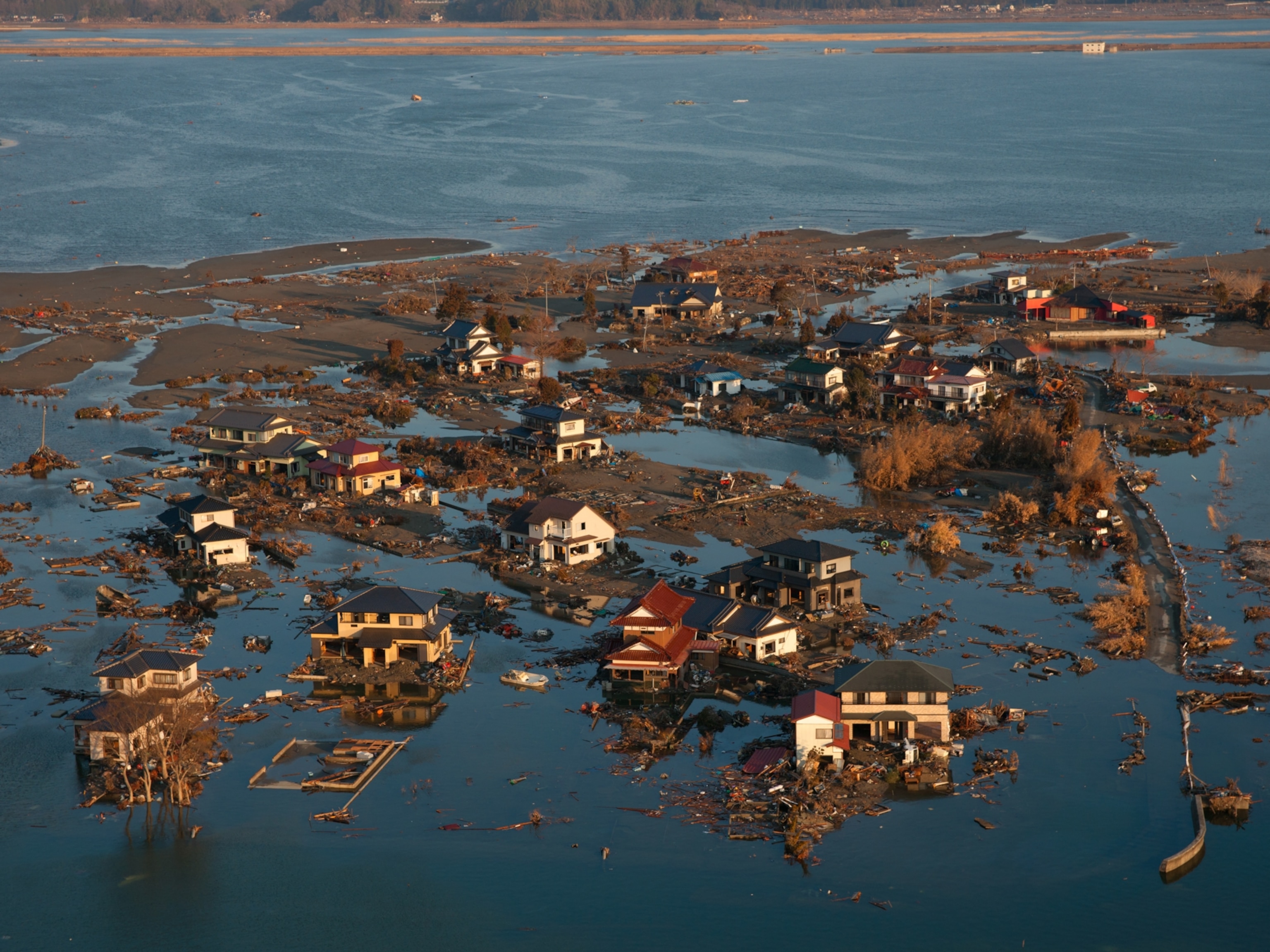
A tsunami is a series of ocean waves that sends surges of water, sometimes reaching heights of over 100 feet (30.5 meters), onto land. These walls of water can cause widespread destruction when they crash ashore.
What Causes a Tsunami?
These awe-inspiring waves are typically caused by large, undersea earthquakes at tectonic plate boundaries. When the ocean floor at a plate boundary rises or falls suddenly, it displaces the water above it and launches the rolling waves that will become a tsunami.
Most tsunamis–about 80 percent–happen within the Pacific Ocean’s “Ring of Fire,” a geologically active area where tectonic shifts make volcanoes and earthquakes common.
Tsunamis may also be caused by underwater landslides or volcanic eruptions. They may even be launched, as they frequently were in Earth’s ancient past, by the impact of a large meteorite plunging into an ocean.
Tsunamis race across the sea at up to 500 miles (805 kilometers) an hour—about as fast as a jet airplane. At that pace, they can cross the entire expanse of the Pacific Ocean in less than a day. And their long wavelengths mean they lose very little energy along the way.

In deep ocean, tsunami waves may appear only a foot or so high. But as they approach shoreline and enter shallower water they slow down and begin to grow in energy and height. The tops of the waves move faster than their bottoms do, which causes them to rise precipitously.
What Happens When It Hits Land
A tsunami’s trough, the low point beneath the wave’s crest, often reaches shore first. When it does, it produces a vacuum effect that sucks coastal water seaward and exposes harbor and sea floors. This retreating of sea water is an important warning sign of a tsunami, because the wave’s crest and its enormous volume of water typically hit shore five minutes or so later. Recognizing this phenomenon can save lives.
A tsunami is usually composed of a series of waves, called a wave train, so its destructive force may be compounded as successive waves reach shore. People experiencing a tsunami should remember that the danger may not have passed with the first wave and should await official word that it is safe to return to vulnerable locations.
Some tsunamis do not appear on shore as massive breaking waves but instead resemble a quickly surging tide that inundates coastal areas.
The best defense against any tsunami is early warning that allows people to seek higher ground. The Pacific Tsunami Warning System, a coalition of 26 nations headquartered in Hawaii, maintains a web of seismic equipment and water level gauges to identify tsunamis at sea. Similar systems are proposed to protect coastal areas worldwide.
13 Striking Photographs of Natural Disasters


Related Topics
You May Also Like


Go Further
Animals
- How can we protect grizzlies from their biggest threat—trains?How can we protect grizzlies from their biggest threat—trains?
- This ‘saber-toothed’ salmon wasn’t quite what we thoughtThis ‘saber-toothed’ salmon wasn’t quite what we thought
- Why this rhino-zebra friendship makes perfect senseWhy this rhino-zebra friendship makes perfect sense
- When did bioluminescence evolve? It’s older than we thought.When did bioluminescence evolve? It’s older than we thought.
- Soy, skim … spider. Are any of these technically milk?Soy, skim … spider. Are any of these technically milk?
Environment
- Are the Great Lakes the key to solving America’s emissions conundrum?Are the Great Lakes the key to solving America’s emissions conundrum?
- The world’s historic sites face climate change. Can Petra lead the way?The world’s historic sites face climate change. Can Petra lead the way?
- This pristine piece of the Amazon shows nature’s resilienceThis pristine piece of the Amazon shows nature’s resilience
- Listen to 30 years of climate change transformed into haunting musicListen to 30 years of climate change transformed into haunting music
History & Culture
- Meet the original members of the tortured poets departmentMeet the original members of the tortured poets department
- Séances at the White House? Why these first ladies turned to the occultSéances at the White House? Why these first ladies turned to the occult
- Gambling is everywhere now. When is that a problem?Gambling is everywhere now. When is that a problem?
- Beauty is pain—at least it was in 17th-century SpainBeauty is pain—at least it was in 17th-century Spain
Science
- Here's how astronomers found one of the rarest phenomenons in spaceHere's how astronomers found one of the rarest phenomenons in space
- Not an extrovert or introvert? There’s a word for that.Not an extrovert or introvert? There’s a word for that.
- NASA has a plan to clean up space junk—but is going green enough?NASA has a plan to clean up space junk—but is going green enough?
- Soy, skim … spider. Are any of these technically milk?Soy, skim … spider. Are any of these technically milk?
Travel
- Dina Macki on Omani cuisine and Zanzibari flavoursDina Macki on Omani cuisine and Zanzibari flavours
- How to see Mexico's Baja California beyond the beachesHow to see Mexico's Baja California beyond the beaches
- Could Mexico's Chepe Express be the ultimate slow rail adventure?Could Mexico's Chepe Express be the ultimate slow rail adventure?

