




Tornadoes, explained
Learn how these deadly storms form and wreak havoc, and how you can reduce your risk.
Tornadoes are vertical funnels of rapidly spinning air. Their winds may top 250 miles an hour and can clear a pathway a mile wide and 50 miles long.
Also known as twisters, tornadoes are born in thunderstorms and are often accompanied by hail. Giant, persistent thunderstorms called supercells spawn the most destructive tornadoes.
These violent storms occur around the world, but the United States is a major hotspot with about a thousand tornadoes every year.
"Tornado Alley," a region that includes the area in the eastern state of South Dakota, Nebraska, Kansas, Oklahoma, northern Texas, and eastern Colorado, is often home to the most powerful and destructive of these storms. U.S. tornadoes cause 80 deaths and more than 1,500 injuries per year.
What is a tornado?
A tornado is a violently rotating column of air that extends from a thunderstorm to the ground. It's often portended by a dark, greenish sky. Black storm clouds gather. Baseball-size hail may fall. A funnel suddenly appears, as though descending from a cloud. The funnel hits the ground and roars forward with a sound like that of a freight train approaching. The tornado tears up everything in its path.
Every U.S. state has experienced twisters, but Texas holds the record: an annual average of 120. Tornadoes have been reported in Great Britain, India, Argentina, and other countries, but they are most often seen in the United States.
Related to tornadoes, waterspouts are weak twisters that form over warm water. They sometimes move inland and become tornadoes.
Dust devils are small, rapidly rotating columns of air that are made visible by the dust and dirt they pick up. Dust devils are not associated with thunderstorms. Either are fire tornadoes, which can spawn from wildfires.
What causes tornadoes?
The most violent tornadoes come from supercells, large thunderstorms that have winds already in rotation. About one in a thousand storms becomes a supercell, and one in five or six supercells spawns off a tornado.
Tornadoes can occur at any time of year, but they are more common during a distinct season that begins in early spring for the states along the Gulf of Mexico. The season follows the jet stream—as it swings farther north, so does tornado activity. May generally has more tornadoes than any other month, but April's twisters are sometimes more violent. Farther north, tornadoes tend to be more common later in summer.
Although they can occur at any time of the day or night, most tornadoes form in the late afternoon. By this time the sun has heated the ground and the atmosphere enough to produce thunderstorms.
Tornadoes form when warm, humid air collides with cold, dry air.
The denser cold air is pushed over the warm air, usually producing thunderstorms. The warm air rises through the colder air, causing an updraft. The updraft will begin to rotate if winds vary sharply in speed or direction.
As the rotating updraft, called a mesocycle, draws in more warm air from the moving thunderstorm, its rotation speed increases. Cool air fed by the jet stream, a strong band of wind in the atmosphere, provides even more energy.
Water droplets from the mesocyclone's moist air form a funnel cloud. The funnel continues to grow and eventually it descends from the cloud. When it touches the ground, it becomes a tornado.

Characteristics of tornadoes
Twisters are usually accompanied or preceded by severe thunderstorms and high wlnds. Hail is also common.
Once a tornado hits the ground, it may live for as little as a few seconds or as long as three hours.


The average twister is about 660 feet wide and moves about 30 miles an hour. Most don't travel more than six miles before dying out.
Massive tornadoes, however—the ones capable of widespread destruction and many deaths—can roar along as fast as 300 miles an hour.
These measurements are scientists' best estimations. Anemometers, which measure wind speed, cannot withstand the enormous force of tornadoes to record them.
Using units F0 to F5, the Fujita scale measures a tornado's intensity by analyzing the damage the twister has done and then matching that to the wind speeds estimated to produce comparable damage. The United States now uses the EF (Enhanced Fujita) scale, which takes more variables into account when assigning wind speeds to a tornado.
Tornado destruction
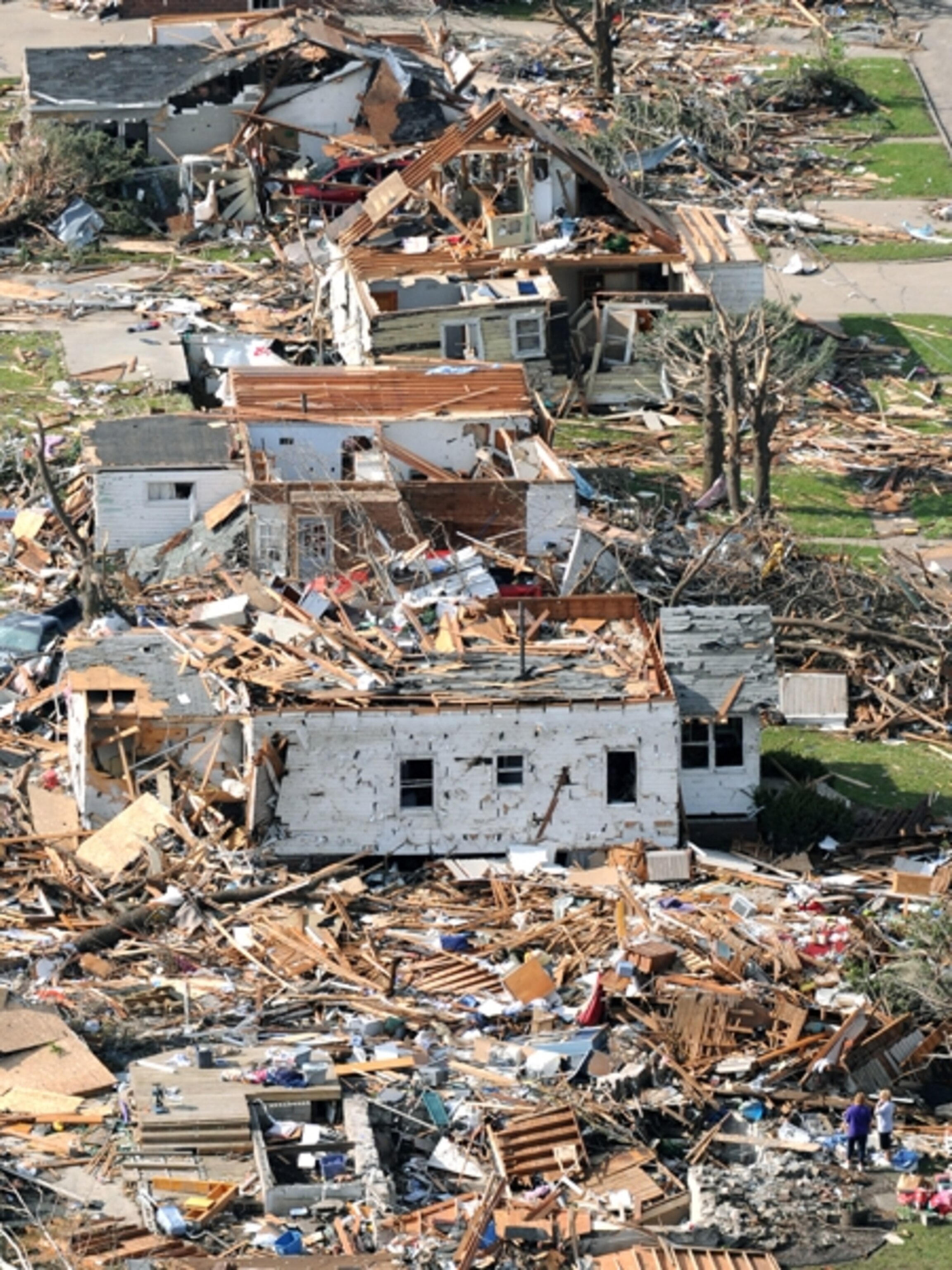
Every year in the United States, tornadoes do about 400 million dollars in damage and kill about 70 people on average.
Extremely high winds tear homes and businesses apart. Winds can also destroy bridges, flip trains, send cars and trucks flying, tear the bark off trees, and suck all the water from a riverbed.
High winds sometimes kill or injure people by rolling them along the ground or dropping them from dangerous heights. But most tornado victims are struck by flying debris—roofing shingles, broken glass, doors, metal rods.
The number of average deaths per year in the United States used to be higher before improved forecasting and warning systems were put into place.
How tornadoes are forecasted
Meteorologists at the U.S. National Weather Service use Doppler radar, satellites, weather balloons, and computer modeling to watch the skies for severe storms and tornadic activity.
Doppler radars record wind speeds and identify areas of rotation within thunderstorms. Since Doppler radar has been in use, the warning time for tornadoes has grown from fewer than five minutes in the 1980s to an average of 13 minutes by the late 2000s.
13 Striking Photographs of Natural Disasters


When weather conditions are conducive for tornado formation, the National Weather Service issues a tornado watch. When a tornado has been sighted or indicated on radar, a tornado warning is issued.
Some scientists, meteorology buffs, and adrenaline junkies hit the road during tornado season to chase storms. Researchers race to place sensors in tornadoes' paths. The sensors measure data such as wind speed, barometric pressure, humidity, and temperature.
The challenge for researchers is being in the right place at the right time. Every morning they study weather conditions and head for the area that seems most likely to spawn a twister. They drive through severe storms, dodge lightning, face flash floods, and get pounded by hail—sometimes for years—before ever spotting a tornado.
All at considerable risk. In 2013, National Geographic Explorer Tim Samaras and his team were killed while trying to study a tornado in Oklahoma. (See photos of Samaras's work.)
Related Topics
You May Also Like


Go Further
Animals
- How can we protect grizzlies from their biggest threat—trains?How can we protect grizzlies from their biggest threat—trains?
- This ‘saber-toothed’ salmon wasn’t quite what we thoughtThis ‘saber-toothed’ salmon wasn’t quite what we thought
- Why this rhino-zebra friendship makes perfect senseWhy this rhino-zebra friendship makes perfect sense
- When did bioluminescence evolve? It’s older than we thought.When did bioluminescence evolve? It’s older than we thought.
- Soy, skim … spider. Are any of these technically milk?Soy, skim … spider. Are any of these technically milk?
Environment
- Are the Great Lakes the key to solving America’s emissions conundrum?Are the Great Lakes the key to solving America’s emissions conundrum?
- The world’s historic sites face climate change. Can Petra lead the way?The world’s historic sites face climate change. Can Petra lead the way?
- This pristine piece of the Amazon shows nature’s resilienceThis pristine piece of the Amazon shows nature’s resilience
- Listen to 30 years of climate change transformed into haunting musicListen to 30 years of climate change transformed into haunting music
History & Culture
- Meet the original members of the tortured poets departmentMeet the original members of the tortured poets department
- Séances at the White House? Why these first ladies turned to the occultSéances at the White House? Why these first ladies turned to the occult
- Gambling is everywhere now. When is that a problem?Gambling is everywhere now. When is that a problem?
- Beauty is pain—at least it was in 17th-century SpainBeauty is pain—at least it was in 17th-century Spain
Science
- Here's how astronomers found one of the rarest phenomenons in spaceHere's how astronomers found one of the rarest phenomenons in space
- Not an extrovert or introvert? There’s a word for that.Not an extrovert or introvert? There’s a word for that.
- NASA has a plan to clean up space junk—but is going green enough?NASA has a plan to clean up space junk—but is going green enough?
- Soy, skim … spider. Are any of these technically milk?Soy, skim … spider. Are any of these technically milk?
Travel
- Dina Macki on Omani cuisine and Zanzibari flavoursDina Macki on Omani cuisine and Zanzibari flavours
- How to see Mexico's Baja California beyond the beachesHow to see Mexico's Baja California beyond the beaches
- Could Mexico's Chepe Express be the ultimate slow rail adventure?Could Mexico's Chepe Express be the ultimate slow rail adventure?
